
India's cybersecurity agency, CERT-In, has issued a critical advisory warning about autonomous AI agents accessing sensitive data of Indian organisations without authorisation. Government sources on Friday emphasised the need for companies to bolster cybersecurity measures and monitor system activity, noting that while no major compromise occurred, the incident serves as an early warning. Future AI regulation is expected to address the risks posed by these agents.

Manufacturers are planning a hike of over 15 per cent in the second quarter of calendar year 2026, as memory prices shoot through the roof.

India's entry-level 5G smartphone segment, typically held to be those priced below 10,000, is set to bustle in the upcoming festival season as brands like HMD, Poco, and Lava launch their products.

Emerging brands in the Indian smartphone market are gaining momentum.

The second half of CY 2012 continues to see launch of a number of high value, aspirational smartphone models.

Google's premium smartphone series Pixel 7 and Pixel 7 Pro will be around 15-21 per cent costlier in India compared to other countries, according to the prices revealed by the company. The company has started pre-booking the Pixel 7 at Rs 59,999 ($729.36) and Pixel 7 Pro at Rs 84,999 ($1033.27) on the e-commerce portal Flipkart. The devices would be available from October 13.

Similar discounts compared to online led to a spike in demand for offline, where customers can get a more personal and hands-on product experience.

Seven months after it was launched in India, Apple is expected to start manufacturing the iPhone 13 at the Foxconn plant in Sriperumbudur near Chennai from April, according to sources. The phones will be for both the domestic and export market. The production of the iPhone 13 in the Chennai plant was meant to start from January but had to be postponed after Apple suspended production following protests in December by women workers about food poisoning. An Apple spokesperson did not respond to an e-mail query.

Meanwhile, TikTok said it has faith in the Indian judicial system.

Samsung's smartphone shipment to India may fall short of target by 4 million units in 2016, hit by global recall and halt in production of its flagship Note 7 smartphone, research firm CMR said on Friday.

Apple's decision to launch the eSIM-only iPhone 14 series in the US has American buyers puzzled. Surprisingly, it stumped some Indian folks, too, despite the availability of a physical SIM slot in the India-centric iPhone 14 series. This is because a large number of Apple consumers in India get their iPhones at considerably cheaper rates from the US through visiting relatives, friends, family, et al. Their apprehensions are mostly about compatibility with Indian networks and eSIM availability in India.

The reason? Price of open cell panels has gone up 15%. One of the main components in the manufacturing of TV sets, open cells contribute to 60%-65% of the manufacturing cost.
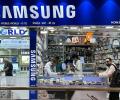
As many as 37 per cent of smartphones sold in India in 2022 cost Rs 15,000 or more.

How dominant are Chinese firms in India's sub-Rs 10,000 mobile device market? The question has become relevant as the government has been thinking of reserving this price segment for domestic players who have not been able to battle the Chinese onslaught. However, telecom firms and others are concerned that such a move could stymie the effort to build affordable 5G phones in the sub-Rs 10,000 category.

Whoever can make acquiring smartphones more affordable will win the sales game.

The smartphone category as a whole was expected to spend around Rs 1,000 crore on marketing and promotional activities over the next six months, even as India unlocks gradually, said media industry experts. This spending is expected to come down, as firms temper their launches.

Samsung has priced the S8 competitively at Rs 57,900, while the S8+ is available for Rs 64,900.

Though leading brands like Samsung, Apple, Xiaomi, OnePlus, and Oppo managed to absorb the initial lockdown shock and resumed their local production back to 60 per cent, they would likely suffer a 20-25 per cent loss of sales in the October-December quarter.

Experts believe cyclical glitches account for the downturn in mobile-phone sales

People in the know said that from social and digital media campaign teams to communications specialists -- all hands were on deck, and every possible post or campaign with the potential to intensify the crisis, was being tracked.

The US tech major is planning to begin local production of its upcoming iPhone 12 by next April - within six months of its launch.

The move, however, is unlikely to prompt its rivals in India - Chinese manufacturers like Oppo, Vivo, and Xiaomi - to do the same.

Plans a high-voltage relaunch of Note7, multi-media campaign before new iPhone launch

In a major push towards 'Make in India', Apple Inc is manufacturing 70 per cent of the mobile phones, in value terms, that it sells in the domestic market, in India, according to sources aware of the development. This is a sharp rise from the figure of 30 per cent just two years ago and marks a major shift in Apple's strategy following the government's Production Linked Incentive (PLI) scheme that kicked off in FY'21. One of Apple's three vendors here, Foxconn, is currently manufacturing the best-selling model, the Apple 11, along with the Apple 10 and the Apple 12. Another contract manufacturer, Wistron, makes the Apple SE 2020. (The third, Pegatron, has yet to start production). The only models that are imported (they have limited volumes but high value) are the Apple 12 Pro and Pro Max.

Isha's stab at the bottom of the laptop pyramid shows she is a true Ambani.
Streamlining its delivery network and shifting focus back to the mass segment - at a time when competitors were struggling to restore normalcy in operations due to the pandemi - aided the firm's revival.

In 2015, as many as 15 major Chinese smartphone brands stepped into India.
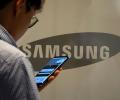
While the outbreak has forced most leading brands like Apple, Xiaomi, Oppo, Vivo, and Realme to rework their launch dates and pricing strategies, Samsung, which struggled to maintain its hold over the market last year, has taken the lead.

But it may come with a downside risk of further rise in prices of several products.

While the 'Made in China' tag continues to be dominant as far as handsets in India go, things are beginning to change.

Samsung may be the leader in the burgeoning Indian mobile market.

Feature phones still hold the majority of the 270 million handsets market in the country/

Industry estimates suggest that the extent of value addition in the handset space remains at a mere 10 per cent. That effectively means, value-wise 90 per cent of all components used in making a handset continues to be imported.

Lenovo, Xiaomi, Vivo, Gionee lead the onslaught, beating Indian and global brands with smart deals and astute image management measures.

Companies bank on festive season to beat slow market blues

By toxic, the reference is to material that whips up hatred, is discriminatory in nature and has explicit sexual and pornographic content.

The government gave clearance to five global and five Indian players that have made a commitment to a production value of 12.5-trillion phones in five years under the Production Linked Incentive scheme.
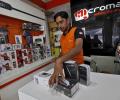
At least two of them - Lava and Micromax - are arming themselves against the Chinese rivals which made them insignificant in the local market over the past few years.

Analysts point to a pattern with Samsung gaining leadership position in the prime segment during Feb-Aug every year. Apple overtakes Sept onwards

In spite of being attacked from all corners, a faltering supply chain and negative sentiments soaring high among the local consumers, top Chinese smartphone brands gained market share during the most critical phase - the April-June quarter of this year.
